Pre-process
and analysis tab
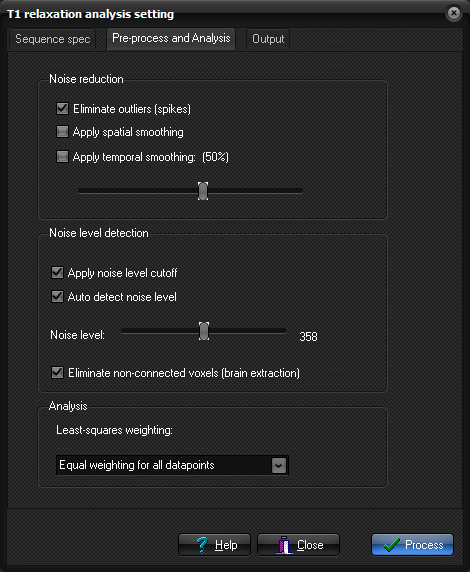
Noise reduction
Eliminate outliers (spikes):
The highest 2% of the voxel intensities of the output images are
set to the intensity of the 98-percentile value.
Apply spatial smoothing:
Nearest neighbour spatial smoothing is applied to the input data
prior to analysis
Apply temporal smoothing:
Time-domain smoothing is applied to input data prior to
analysis. The degree of temporal smoothing can be adjusted by the slider
Noise level
Apply noise level cutoff
Voxel intensities below the specified cutoff value are excluded
from the analysis
Auto-detect noise level:
The noise level in the input data is automatically estimated
using the Otsu’s method.
Noise level:
Override the auto-detected noise level by adjusting the slider
Eliminate non-connected voxels:
Performs seed growing from, starting from the image volume centre
of gravity and eliminating all voxels not connected to the centroid voxel
Least squared
weighting
Determines the relative weighting in the iterative least squares
curve fitting procedure of the individual datapoints of the input data
Equal weighting for all datapoints: all datapoints are weighted equally,
independent of amplitude
Increasing weighting of higher amplitudes: higher amplitude values are given a higher
weight which means that they contribute more to the LSQ solution
Increasing weighting of lower amplitudes: lower amplitude values are given a higher
weight which means that they contribute more to the LSQ solution
Related topics:
T1 / R1 relaxation analysis

|