Sequence
specifications tab
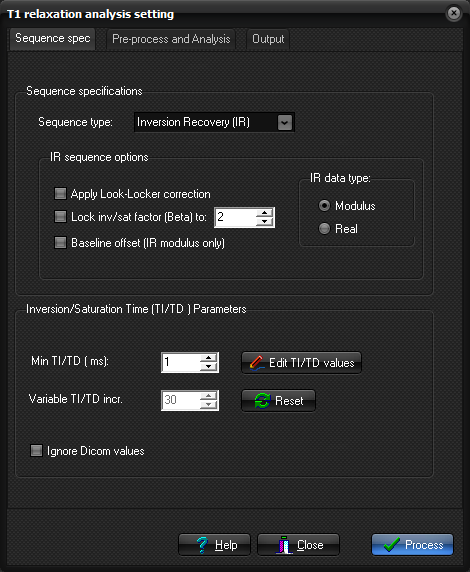
Sequence specification:
Sequence
type:
Available
options: Inversion Recovery (IR), Saturation Recovery (SR) or multiple
flip angle spoiled gradient echo (SPGR)
For
IR type, subtypes can be Modulus or Real:
Modulus
curve:
Negative
values on the IR curve are represented as the modulus value.
Real
curve:
negative
pixel values are allowed
If sequence type is set to either SR or IR then multiple sequence related options can be
set in the IR sequence option panel:
Apply
Look-Locker correction:
Corrects
the calculated T1/R1 values for the effect of signal saturation in
Look-Locker type sequences (multiple RF excitation pulses after a single
inversion pulse). The flip angle must be specified when this option is enabled,
and the option is only valid for IR curves.
Correct
for imperfect inversion pulse:
When
T1 is estimated from an Inversion Recovery (IR) sequence, the formula used
is: SI(TI) = A[1- B exp(-TI/T1)] where TI is the
inversion time, A is a constant reflecting equilibrium magnetization and B is
a value reflecting the magnitude of the inversion (180 deg)
pulse. For a 'perfect' IR sequence B=2, but the value may deviate from 2 when
the B1-excitation field is imperfect, causing the value of B to vary across
the field of view. When this option is enabled, the parameter B is allowed to
vary (i.e. included as a parameter to be fitted).
This will account for variations in the inversion pulse, but also increases
the number of degrees of freedom in the fitting procedure, which can result
in greater variation in the resulting R1/T1 estimation. Note that when the
option 'Apply
Look-Locker correction' is enabled, correction for imperfect
inversion pulse is always applied, since this is part of the Look-Locker correction
algorithm.
Baseline
offset: When enabled, an offset parameter
is added to the model expression to account for the fact that the signal
level never reaches zero for modulus IR curves (due to image noise). This
option is not used for SR images of for real IR data
Inversion/Saturation
time (TI/TD) Parameters:
Constant
TI/TD spacing: Selected if a constant
inversion or delay time spacing is used. Min TI/TD is the time of
the first inversion/saturation time and Delta TI/TD is
the spacing of successive time-points after the first TI/TD
time. All times are in msec.
Edit
TI/TD values: The inversion- or
delay times are specified in a list. This would be used in
situations where the TI/TD values are sampled
at uneven intervals (and not specified in the DICOM header).
Ignore
Dicom values: If
TI values are present in the DICOM header, but one wishes to use other
values.
Multiple
flip-angle SPGR sequence parameters:
Constant
flip angle increment/decrement: Selected
if a constant flip angle increment or decrement is used. First FA is the flip
angle of the first image and FA increment/decrement is the constant change in
flip angle for each consecutive image in the series. All values are in
degrees.
Edit
flip angles: The flip angles used are
specified in a list. This would be used in situations where a non-constant
flip angle increment or decrement is used (and the values are not specified
in the DICOM header).
Repetition
time: Specifies the repetition time (TR)
of the SPGR sequence
Ignore
Dicom values: If valid
flip angles and TR values are present in the DICOM header, but one wishes to
use other values.
Related topics:
T1 / R1 relaxation analysis

|