The Parameters Tab
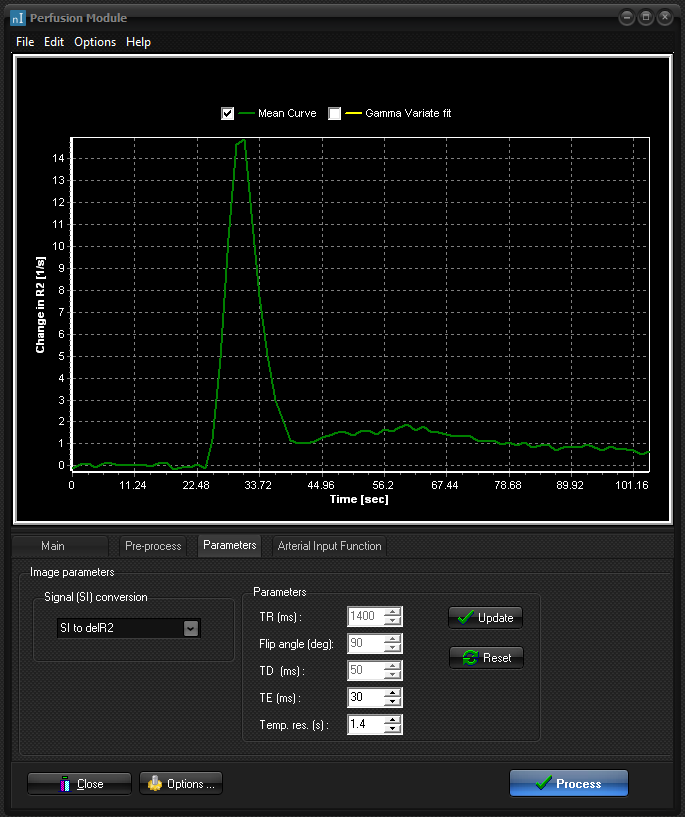
Signal (SI)
conversion
Specify how the signal
time curves in the input images should be converted prior to analysis:
- SI to delR2:
the SI is converted to relative change in R2 (i.e
R2* = 1/T2*) using the standard expression: delR2(t) = -ln(S(t)/So)/TE
where S is the SI at time t, So is the baseline
SI and TE is the echo time.
- SI to relSI (%): the SI is converted to percent change in SI using
the expression: relSI(t) =
100*(S(t)-So)/So
- SI to delSI: the SI is converted to SI difference from baseline:
delSI(t) = S(t)-So.
This conversion is typically used for CT images.
- 1/T1 from SPGR: converts to change in 1/T1 relaxation rate for spoiled
gradient echo (GRE) sequence. Flip angle and repetition time (TR) must
be specified in the <Parameters> field or be available from the
image header (for Dicom images).
- 1/T1 from SR:
converts to change in 1/T1 relaxation rate for saturation recovery (SR)
sequence. Delay time (TD)must be specified in the <Parameters>
field.
- None:
the input signal is not modified. Note that this setting assumes the
input images to already be converted to either relative SI change or
delR2 change.
Note
that the first-pass curve should always have a 'positive' peak .
If the first-pass curve has a negative peak or a non-zero baseline value, you
need to convert it using the appropriate SI conversion function.
Note
that the most common signal conversion for perfusion analysis is SI to delR2, when the input data is T2/T2* weighted (dynamic
susceptibility contrast).
Image parameters
For
DICOM images, these parameters are usually automatically extracted from the
image header. If the parameters cannot be determined a warning message is
issued and the values must be set manually. Note that the TE value is only
needed if the data is to be converted from SI to delR2. Note that the
temporal spacing between successive dynamic images is assumed to be constant.
If the spacing is not constant (as determined from the DICOM headers) then a
warning message is issued and the temporal spacing of the first two images is
used.

|